Valorant aim practice: what to drill and what carries over
Good Valorant aim practice is short, daily and done on your real sensitivity. Train crosshair placement at head height first, then stopping before you shoot, first-bullet accuracy and small corrections. The 15-minute routine below uses ten free drills. Speed comes later, and no drill replaces playing against people.
Updated
What should you practise first?
Practise crosshair placement and stopping before you practise flicks, because they decide whether you need a flick at all. A crosshair at head height on the edge of cover turns a duel into a small correction. In Riot's playtests of evenly matched, highly skilled players, the difference between winning and losing a gunfight often came down to 20 to 50 ms.
Stopping matters because of how Valorant counts accuracy. A standing Vandal's first shot has 0.25° of spread. Running adds 6°, walking adds 3° and crouch-walking adds 0.8°. You only count as standing once you drop under 27.5% of your maximum speed. In Riot's 2020 test, counter-strafing a full run to a stop took 0.160 s and reached the then-25% deadzone in 0.104 s. The stop has to happen every time, not just when you remember it.
AimKata's Path follows that order: setup, crosshair placement, stopping, flicks and micro-adjustments, tap and spray, holding angles, peeking, then awareness.
What does a 15-minute routine look like?
Ten free drills in the order the fundamentals build. Minutes are AimKata's own estimate for each drill and include the countdown and the results screen. Play them in Training, then make the last one Ranked so it counts.
Grid Flick
Warm up the hand. Flick to the target and let a small correction finish it. Do not spam: accuracy multiplies the score.
1.3minOpen drillStrafe Track
Match the bot’s speed and react to its direction changes instead of guessing them.
1.1minOpen drillClear the Angles
Walk the route with your crosshair already at head height. Clear one angle at a time, and stop before you shoot.
2.3minOpen drillPeek Duel
Peek with A or D, tap the opposite key to stop, then shoot. Shots fired while moving miss.
2minOpen drillMicro Flick
Head-sized targets 1 to 6° apart. Use your fingers and wrist, and click when you are on it, not when you are almost on it.
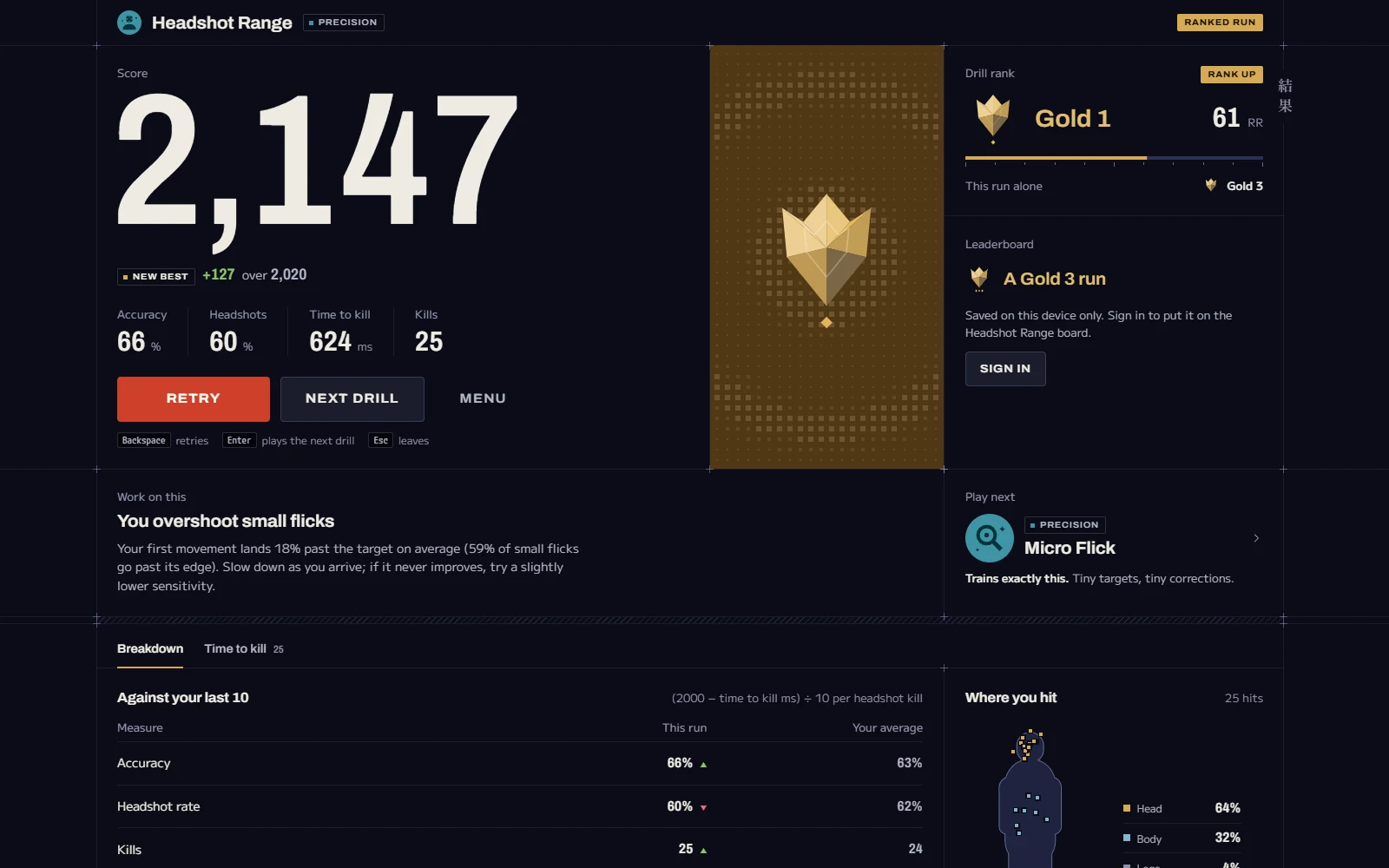
1.3minOpen drillHeadshot Range
Bots at 10 to 25 m, and only headshots count. Have the crosshair at head height before the bot appears.
1.4minOpen drillSpray Control
A full magazine at a bot 10 m away. Pull down slightly ahead of the climb, and read your pattern after each rep.
1minOpen drillBurst & Tap
Bots at 22 to 35 m. Tap the first bullet at the head, then burst and reset rather than holding the trigger.
1.1minOpen drillReflex
Targets appear near your crosshair after a random delay and leave after 0.9 s. Do not anticipate.
1.1minOpen drillSite Hold
Finish with one Ranked run. Hold a few pixels off the edge at head height, and aim at the lane the footsteps name next.
2.4minOpen drill
| Time | Drills | Use it for |
|---|---|---|
| About 5 minutes | Grid Flick, Strafe Track, Micro Flick, Headshot Range | A warm-up before a ranked game. Stop there: a warm-up is not the place to chase a score. |
| About 15 minutes | The routine above | A normal day |
| About 30 minutes | The routine, then Sound Locate, Wide Flick, Mixed Flicks and a second run of Clear the Angles, Peek Duel, Micro Flick, Spray Control, Burst & Tap and Site Hold | A longer day, or a day to work on your weakest skill. Stats tells you which one that is. |
| Your Valorant rank | Practise first | Drills | Pass mark to aim for |
|---|---|---|---|
| Iron and Bronze | Head-height crosshair and stopping before you shoot | Clear the Angles, Peek Duel | Silver 1 on Clear the Angles (a score of 2,042), and 70% stable shots on Peek Duel |
| Silver and Gold | Tap, burst, flick and small corrections | Grid Flick, Micro Flick, Burst & Tap, Spray Control | Gold 1 on Grid Flick (a score of 8,512) and Gold 1 on Spray Control (a score of 186.7) |
| Platinum and Diamond | Holding and peeking angles on purpose | Site Hold, Reflex, Peek Duel, Sound Locate | Platinum 1 on Site Hold (a score of 8,523), Platinum 1 on Peek Duel (a score of 1,554) and Diamond 1 on Sound Locate (a score of 10,671.3) |
| Ascendant and above | Your weakest skill, then consistency | Site Hold on Hard or Elite, Micro Flick and your lowest skill on Stats | Keep your weakest skill above Diamond 1, and treat this as 10 to 15 minutes of upkeep |
AimKata scores measure drills. They are not your rank in Valorant and do not predict it.
What sensitivity should you practise on?
Practise on the sensitivity you use in Valorant, and do not change it within a session. Your turn distance is 360 ÷ (0.07 × sensitivity × DPI) × 2.54 cm, which is 13,062.857 ÷ eDPI, where eDPI is sensitivity times DPI. A sensitivity of 0.35 at 800 DPI is eDPI 280 and 46.7 cm for a full turn.
There is no single right number, and published ones disagree. prosettings.net reports an average eDPI of 267 and a median of 240 across 705 pros (page modified 18 May 2026), and says the average pro needs about 45 cm for a full turn. By the formula above, eDPI 267 is 48.9 cm and eDPI 240 is 54.4 cm.
We counted the first 100 of the 679 players on its Valorant list on 10 November 2026. Their median was 60.5 cm, the middle half sat between 50.1 and 74.2 cm, and eight in ten sat between 35.9 and 81.6 cm. That is a wide band, and one site's list in the order it shows them, so read it as a range to stay inside, not as a target. If a guide prints a range of 200 to 400 eDPI next to a small cm figure, check it: at Valorant's 0.07, eDPI 200 is 65.3 cm and eDPI 400 is 32.7 cm.
On Pro, AimKata's sensitivity finder plays five rounds of Mixed Flicks, each at a different sensitivity, and shows which one you aimed best with.
| What you practise | Carries over? | Why |
|---|---|---|
| Turn distance and sensitivity | Yes | The same 0.07° per count and the same 103° horizontal view, so the same sensitivity and DPI give the same turn. |
| Scopes and aiming down sights | Yes | AimKata uses Valorant’s rule of multiplier ÷ zoom: 1.25x for the Vandal and Phantom, 2.5x and 5x for the Operator. |
| Stopping before you shoot | Yes | The same 27.5% deadzone (15% for the Operator), with rifle run speed at 5.40 m/s and a stop fitted to Riot’s 0.16 s. |
| First-shot accuracy | Yes | First-shot spread and movement penalties are Valorant’s, gun by gun. |
| Your crosshair | Yes | Paste the same profile code. It draws pixel for pixel. |
| Spray patterns | Partly | Riot publishes no per-bullet recoil data, so the patterns are approximations. Bursts and pulling down transfer; memorising a pattern exactly does not. |
| Head size | Partly | Valorant’s head hitbox is not published. AimKata’s is an estimate of 0.22 by 0.25 m on a 1.96 m body. |
| Walking and crouching speed | Partly | Riot does not publish them, so AimKata uses estimates of 53% and 47% of run speed. |
| Reading real players | No | Bots follow scripted peeks and strafes. They cannot fake, bait or adapt to you. |
| Map knowledge | No | AimKata’s maps are original. Timings, lineups and callouts stay in Valorant. |
| Ping and peeker’s advantage | No | Riot measured peekers getting about 71 to 141 ms more time to react, depending on conditions. Drills run on your machine with no server. |
| Abilities, economy and team play | No | None of them exist in the trainer. |
Does aim practice actually help your rank?
We could not find a peer-reviewed study that tests aim-trainer practice against match results, so test it on yourself. The closest study we read, a 2024 pilot with 10 esports players, found that repeated KovaaK's scores were reliable (intraclass correlations of 0.947 to 0.995) and warned that "caution is required if extrapolating to in-game environments."
Treat any trainer score as a measure of the drill. To see whether it reaches your games, track a Valorant number you already have, such as first-bullet kills in Deathmatch, alongside your practice trend. If the drill number climbs and the game number does not, spend more time in Deathmatch and less in the trainer.
Common questions
Is the Range enough, or do I need an aim trainer?
The Range uses Valorant’s real guns and physics, so nothing there is an estimate, and it is the right place for sprays and one-taps. A trainer adds repeatable drills, scores and a history between sessions. Use the trainer for mechanics, then Deathmatch to use them on real people.
How long until aim practice shows up in ranked?
Nobody has published a figure we can give you, and it depends on where you start. Practise for a few weeks on one sensitivity, then compare your Ranked drill trend with a number from your matches. Change one thing at a time so you can tell what helped.
Should I warm up before a ranked game?
Yes, but keep it short. The 5-minute version above is enough to get your hand moving. Save long Ranked runs for a day when you are not about to queue, because a bad score just before a game does not help.
Do the drills use real Valorant maps?
No. AimKata’s maps are original training spaces, with a site, a kill house, a duel lane and a range. They practise holding and clearing angles without copying any Riot map, so learn real map timings in the game.
Can I practise the Operator or the Sheriff?
Yes. Sheriff One-Taps is free. Operator Flicks is a Pro drill, and the Operator also works in free drills that allow every gun, such as Grid Flick and Site Hold.
Run the 15 minutes
Set your sensitivity once, then follow the list from the top.
Sources
- Peeking into Valorant's netcode (Riot Games)Read
- Valorant patch notes 3.0: deadzone at 27.5% (Riot Games)Read
- Vandal spread table (Valorant Wiki)Read
- Run-to-stop timings measured by a Riot developer, 2020 (devtrackers.gg)Read
- Valorant pro settings guide, 705 players, modified 18 May 2026 (prosettings.net)Read
- Valorant pro settings list, first 100 of 679 rows counted (prosettings.net)Read
- KovaaK's aim trainer as a reliable metrics platform: a pilot study (Frontiers in Sports and Active Living, 2024)Read
- Valorant sensitivity constants and the rule for multipliers (game-sens.jor.dev)Read
Keep going
- Aim practice online, for any mouse shooterGeneral aim practice for people who have not picked a game: the skills, Fitts difficulty, a first sensitivity by turn distance, and a 10-minute routine.
- A Valorant aim tracker that defines every numberWhat AimKata records per run, how each metric and the aim analysis are defined, the score table for every rank, and how to read progress.
- Valorant aim drills: what to play and whyEvery AimKata drill by skill, with a guide to which of the 21 to play for a given weakness.
- The best crosshairs for Valorant26 Valorant crosshair codes by style, each drawn from its code, 10 sourced pro codes, how to import one, and what AimKata's aim score measures.
- An Aimlabs alternative for Valorant, compared honestlyAn honest comparison of AimKata with Aimlabs and KovaaK's: price, install size, library and where each is better. Not affiliated with Aimlabs.
- The Valorant aim trainer that runs in your browserWhat AimKata is: a free browser Valorant aim trainer, its drills, the Path, tracking, crosshairs and how to start.