A Valorant aim tracker that defines every number
AimKata is a Valorant aim tracker for your practice, not your matches. It saves every run in your browser with its score, accuracy, headshot rate, time to kill and pre-aim error, and turns ranked runs into a rank per skill. It cannot read your Valorant games, so use Valorant's Career page for those.
Updated
What does AimKata track, and what can it not see?
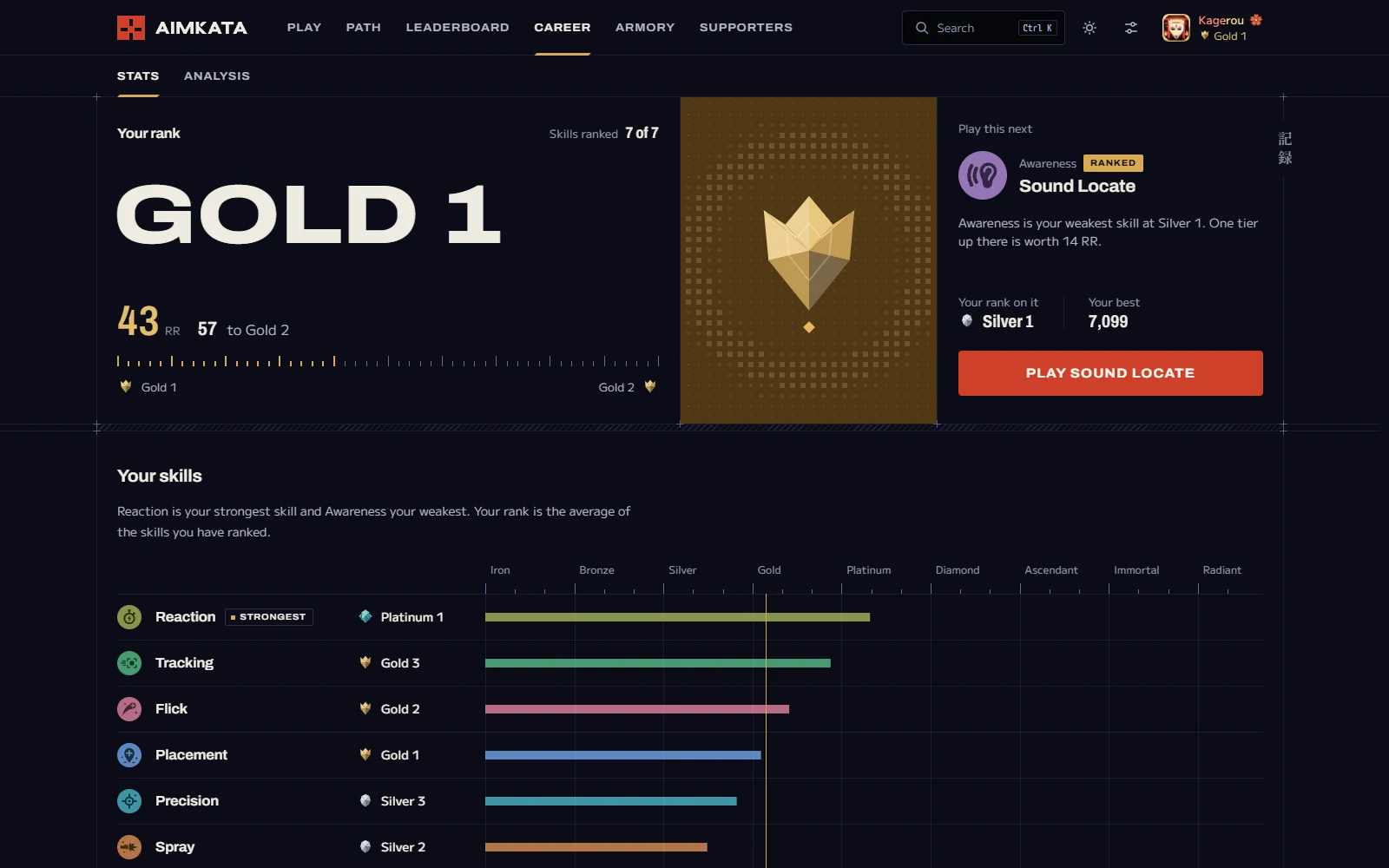
AimKata tracks the drills you play in it, and only those. Every finished run is stored with its score and figures, each drill keeps a trend, and Stats shows a rank per skill along with the drill most likely to move it.
It has no connection to your Valorant account and cannot see your matches, your real rank or your in-game stats. Valorant's Career page shows your Match History and rank. Keep the two separate: AimKata says how your drills are going, and your matches say whether that is reaching the game.
| Metric | Definition | Better when |
|---|---|---|
| Score | Each drill's own formula, printed under the score. Grid Flick is kills × 100 × accuracy; Micro Flick uses accuracy squared; Strafe Track is time on target and on the head. | Higher |
| Accuracy | Hits ÷ shots. | Higher |
| Headshot rate | Headshot hits ÷ all hits, not ÷ kills. | Higher |
| Time to kill | From the target becoming visible (or appearing) to the kill. Shown as an average and a median. | Lower |
| Reaction | From the target becoming visible (or appearing) to your first shot. | Lower |
| Pre-aim error | The angle, in degrees, between your crosshair and the head when a bot first becomes visible. | Lower |
| Stable shots | The share of your shots fired on the ground and at or below the accuracy deadzone: 27.5% of run speed, 15% with the Operator. | Higher |
| On target, on the head | Tracking drills only: the share of the time you are firing that the crosshair is on the target, and on its head. | Higher |
| Direction error | Sound Locate only: how far your aim is from the enemy at the moment it appears, in degrees. | Lower |
| Got away, damage taken, friendly hits | Targets that timed out unkilled, health lost to bots that shoot back, and shots on blue teammates. | Lower |
| Measure | Definition | Unit |
|---|---|---|
| Flick | Starts at the later of your previous click and the target appearing, and ends at the click on it. | |
| Reaction | Target appearing to your aim moving toward it faster than 30° a second, or a quarter of your peak speed in that run if that is lower. | ms |
| Flick time | First movement to the click. | ms |
| Settle | End of the fast first movement to the click. | ms |
| Overshoot | Share of flicks whose fast first movement ends past the target’s edge. Reported beside undershoot and the mean miss as a share of the distance. | % |
| Corrections | Extra small movements between the first movement and the click. | per flick |
| Click distance | How far from the target’s centre you click, as a share of its radius. | % of radius |
| Throughput | Speed and accuracy as one number, using the ISO 9241-9 formula: effective difficulty = log2(distance ÷ effective width + 1), with effective width = 4.133 × the standard deviation of your click positions. AimKata divides total bits by total seconds. | bits/s |
| Tracking error | Average distance between the crosshair and the target’s centre while a target is live. | ° |
| Lag | How far your aim trails the target, from the cross-correlation of their movements. | ms |
| Jitter | Small wobble around the target, measured as the root mean square of its high-frequency part. | ° |
| Hand speed | The 95th-percentile mouse speed in the run. | cm/s |
Flicks are split into four distance bands: micro under 5°, short 5 to 20°, mid 20 to 60° and wide 60° or more.
How does a score become a rank?
Ranked runs always use Standard difficulty, so your scores can be compared. Training runs do not count.
Your drill rank
Take the mean of your three best Ranked scores on a drill and place it on that drill’s score table. It is linear between one tier’s starting score and the next.
Your skill rank
Average your rank across the Ranked drills you have played in that skill.
Your overall rank
Average your skill ranks. It appears once 5 of the 7 skills have a rank.
Your RR
The fraction past your tier, from 0 to 99. Iron 1 to Radiant is 25 tiers, as in Valorant.
| Drill | Iron 1 | Bronze 1 | Silver 1 | Gold 1 | Platinum 1 | Diamond 1 | Ascendant 1 | Immortal 1 | Radiant |
|---|---|---|---|---|---|---|---|---|---|
| Grid Flick | 4,011 | 5,797 | 7,208 | 8,512 | 9,312 | 10,362 | 11,585 | 13,278 | 16,835 |
| Spider Flick | 2,756 | 4,107 | 5,065 | 5,921 | 6,598 | 7,349 | 8,356 | 9,289 | 11,438 |
| Reflex | 533 | 2,950 | 5,550 | 6,967 | 9,083 | 10,433 | 11,667 | 13,283 | 15,633 |
| Micro Flick | 1,282 | 2,642.5 | 2,988 | 4,157.5 | 5,798 | 6,995 | 7,840 | 9,769 | 12,873 |
| Headshot Range | 677 | 1,374 | 1,762 | 2,024.4 | 2,192 | 2,377.7 | 2,653.5 | 3,084 | 3,244.4 |
| Strafe Track | 416 | 536 | 564 | 669 | 757 | 899 | 919 | 1,327 | 1,779 |
| Spray Control | 118 | 137 | 164 | 186.7 | 203 | 237 | 312 | 392 | 505 |
| Burst & Tap | 420 | 631 | 1,101 | 1,283.6 | 1,327.8 | 1,498.5 | 1,709 | 2,228.5 | 2,250.6 |
| Site Hold | 850 | 2,682 | 4,333 | 7,753 | 8,523 | 9,281 | 10,194 | 11,146 | 12,989 |
| Clear the Angles | 400 | 1,033 | 2,042 | 2,388 | 2,905 | 3,176 | 3,593 | 4,126 | 4,968 |
| Peek Duel | 700 | 908 | 1,108 | 1,329 | 1,554 | 1,871 | 2,336 | 2,992 | 4,300 |
| Sound Locate | 705 | 3,926.8 | 6,944.8 | 8,062 | 9,495 | 10,671.3 | 11,993.4 | 13,761 | 18,185 |
These come from a simulated player, run over at least 11 seeds per tier at Standard difficulty and modelled on Fitts’s law, reaction time and precision for each rank. They are not measured from real players and do not predict your Valorant rank. They will be replaced with real percentiles once the leaderboards have enough scores.
How do you read your progress?
Read a trend over one drill, on one sensitivity, in Ranked mode, and never read one run. Stats shows your last five runs of a drill against the five before them once you have six. Analysis compares your last 10 analysed runs with the 10 before them once you have 13, and there a change under 1% shows as no change.
Because your drill rank uses your three best Ranked scores, one bad run never lowers it. It only moves when a new score enters your top three, or when a drill's scoring version changes, which retires old runs from the rank while keeping them in your history. Compare like with like: a change of sensitivity or of gun makes earlier runs a different test.
Where is your data kept?
In your browser, on your machine. Each run's summary is kept for good, and full per-shot detail for each drill's newest 300 runs. Settings, Data exports a backup file and imports it elsewhere. There is no cloud sync of your run history yet.
A guest's runs are never sent anywhere. If you sign in for the leaderboards, your Ranked runs upload the drill, score, accuracy, kills, duration and seed so they can be placed on a board. Leaderboards check runs for plausibility and do not replay them.
Common questions
Can AimKata track my real Valorant matches?
No. AimKata has no link to your Riot account and only records the drills you play in it. For match results, use the Career page in Valorant.
Is my AimKata rank my Valorant rank?
No. It uses the same names, Iron 1 to Radiant, but it ranks drill scores against a simulated player. A Gold on Grid Flick does not mean you are Gold in Valorant.
Why did one bad run not change my rank?
Each drill rank uses the mean of your three best Ranked scores. A poor run does not enter the top three, so it changes nothing. A good run replaces your weakest of the three and lifts the mean.
What is the Daily Kata?
One Ranked drill a day on one fixed seed, the same for everyone, with its own leaderboard. It rotates through seven free drills.
How accurate are these numbers?
They are computed from what happened in the drill on your machine, frame by frame. The rank scores are model-based estimates, and the about page lists what is exact and what is an estimate.
See where you stand
One Ranked drill starts your record.
Sources
Keep going
- Valorant aim practice: what to drill and what carries overA 15-minute Valorant routine with minutes per drill, how to adjust it by rank or time, sensitivity figures with sources, and a table of what transfers to the game.
- Aim practice online, for any mouse shooterGeneral aim practice for people who have not picked a game: the skills, Fitts difficulty, a first sensitivity by turn distance, and a 10-minute routine.
- Valorant aim drills: what to play and whyEvery AimKata drill by skill, with a guide to which of the 21 to play for a given weakness.
- AimKata price and plansThe price of each plan: Free, Pro at $5 a month and Supporter at $50 a month, what each includes, and how billing and cancelling work.
- What is AimKata?What AimKata is, how each Valorant number is matched and which are estimates, how its ranks are defined, and how to reach it.